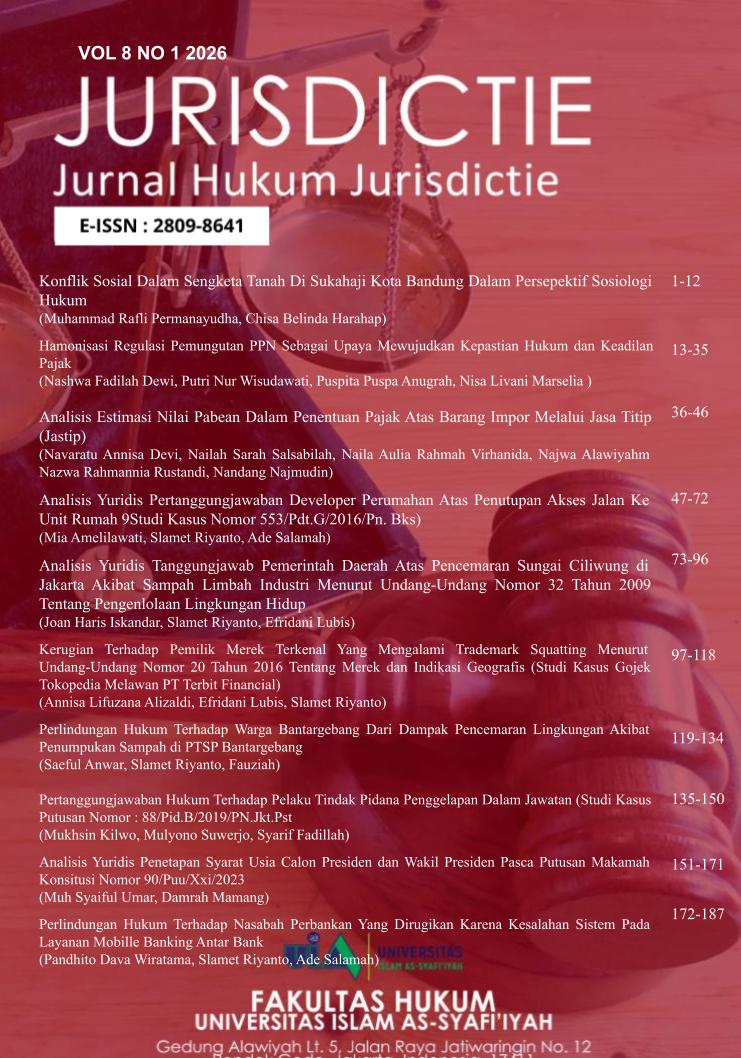
Konflik Sosial Dalam Sengketa Tanah Di Sukahaji Kota Bandung Dalam Persepektif Sosiologi Hukum
Abstract
This study examines the social conflict arising from land disputes in Sukahaji, Bandung City, from the perspective of legal sociology. Employing a qualitative approach with descriptive methods, the research aims to identify the triggering factors of the conflict, analyze its impacts on local community life, and understand the interaction patterns among parties (community, government, and developers). The findings reveal that the conflict is triggered by clashes between the historical-social claims of the community and formal state law, exacerbated by urbanization, power imbalances, and limited community participation. Its impacts include social tensions, economic vulnerabilities, and psychological pressures, while interaction patterns reflect the dominance of government and developers over local communities, prompting resistance through social solidarity. This study underscores the importance of participatory and equitable conflict resolution approaches to strengthen inclusive social order.
Copyright (c) 2026 Jurnal Hukum Jurisdictie

This work is licensed under a Creative Commons Attribution-ShareAlike 4.0 International License.

This work is licensed under a Creative Commons Attribution-ShareAlike 4.0 International License .
Authors who publish with this journal agree to the following terms:
- Authors retain copyright and grant the journal right of first publication with the work simultaneously licensed under a Creative Commons Attribution-ShareAlike 4.0 International License that allows others to share the work with an acknowledgment of the work's authorship and initial publication in this journal.
- Authors are able to enter into separate, additional contractual arrangements for the non-exclusive distribution of the journal's published version of the work (e.g., post it to an institutional repository or publish it in a book), with an acknowledgment of its initial publication in this journal.
- Authors are permitted and encouraged to post their work online (e.g., in institutional repositories or on their website) prior to and during the submission process, as it can lead to productive exchanges, as well as earlier and greater citation of published work (See The Effect of Open Access).